
Fort Loudoun is the product of Washington’s early experiences as a young man – from his start as a surveyor to his relationship with Governor Robert Dinwiddie to his rise in ranks within the Virginia Militia, which takes us to 1756.
Because of the knowledge he gained surveying the western frontier, Washington knew that Virginia needed a strong fort to provide much needed defense for the men, women, and children living in the Shenandoah Valley. The following sections break down the need for Fort Loudoun, why Washington chose Winchester, the frustrations and struggles behind building the fort, the architecture, as well as the well.
Mounting Tensions, Attacks, and Virginia’s Unprotected Frontier
The Enemy have returned in greater numbers; committed several murders not far from Winchester; and even are so daring as to attack our Forts in open day; as your Honor may see by the enclosed Letters and papers. Many of the Inhabitants are in a miserable situation by their losses, and so apprehensive of danger that, I believe, unless a stop is put to the depredations of the Indians; the Blue-Ridge will soon become our Frontier.
From George Washington to Robert Dinwiddie, 7 April 1756 2
With tensions continuing to mount between the British and the French, fear was spreading amongst the colonists, particularly in the largely unprotected and vulnerable western frontier. Washington wrote a letter to Governor Dinwiddie on April 24, 1756 in which he explains,
Not an hour, nay, scarcely a minute passes, that does not produce fresh alarms and melancholy accounts. So that I am distracted what to do! nor is it possible for me to give the people the necessary assistance for their defence; upon account of the small number of men we have, or is likely to be here, for sometime. The Inhabitants are removing daily; and in a short time will leave this County as desolate as Hampshire, where scarce a family lives!
Three families were murdered the night before last at the distance of less than twelve miles from this place: and every day we have accounts of such cruelties and Barbarities, as are shocking to human nature: nor is it possible to conceive the situation and danger of this miserable County: Such numbers of French and Indians all around; no road is safe to travel: and here, we know not the hour how soon we may be attacked!
From George Washington to Robert Dinwiddie, 24 April 1756 3
It’s true that by 1756, families were being attacked by American Indian war parties up and down the Shenandoah Valley. Washington was headquartered in Winchester but most of the Virginia Regiment was stationed at Fort Cumberland, leaving nearly 60 miles of territory unprotected and vulnerable to more attacks, which continued to happen often. In his book, French & Indian War in Frederick County, Virginia, Norman Baker explains, “If a chain of forts is to be erected, he [Washington] said, those forts should not be separated by more than 15 to 18 miles, or more than a day’s march apart. Each should be garrisoned with no less than 80 or 100 men. 5
| Pause to explore! Visit the original document on the Library of Congress website so that you can zoom in and see Washington’s handwriting. How much of the original letter can you read? |
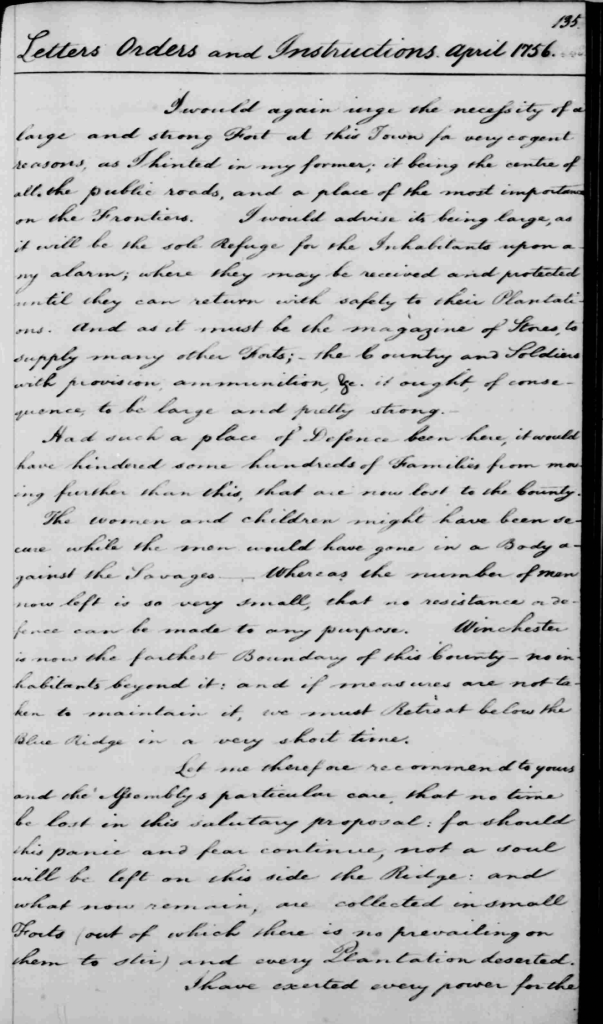
On April 27, 1756, while in Winchester, Washington wrote a letter to John Robinson, the Speaker of The House of Burgesses where he continued to strongly urge for the construction of Fort Loudoun to protect the north-western frontier (key points are in bold).
I would again urge the necessity of a large and strong fort at this town [Winchester] for very cogent reasons, as I hinted in my former, it being the center of all the public roads, and a place of the most importance on the frontiers. I would advise its being large, as it will be the sole refuge for the inhabitants upon any alarm, where they may be received and protected until they can return with safety to their plantations. And as it must be the magazine of stores, to supply many other forts, the country and soldiers with provisions, ammunition, &c., it ought, of consequence, to be large and pretty strong. […]
The women and children might have been secure, while the men would have gone in a body against the savages, whereas the number of men now left is so small, that no resistance or defence can be made to any purpose. Winchester is now the farthest boundary of this county,—no inhabitants beyond it: and if measures are not taken to maintain it, we must retire below the Blue Ridge in a very short time.
George Washington to John Robinson, 27 April 1756 6
In other words, Washington warned the House of Burgesses that they must approve the construction of Fort Loudoun right away, or all of the colonists would be left with no choice but to retreat from Virginia’s unprotected frontier.
The Design
I think the building a Fort at Winchtr absolutely necessary, after the Plan is properly laid down they can be at Work on it when You come here, but Yr absence must be very short.
From Robert Dinwiddie to George Washington, Williamsburg, 27 May 1756 7
After many candid correspondences, the House of Burgesses approved Washington’s request to build Fort Loudoun in Winchester, Virginia. Governor Dinwiddie wrote to Washington on May 3, 1756, expressing his concern over the French and American Indian war parties, approving the fort’s construction, and detailing Washington’s orders:
I approve, for the Reasons You assign, the fortifying of Winchester, & when the Militia arrives You may employ many of them on that Business, & if they expect extra Pay for that Service, You must agree with them accordingly; there are ten Cannon at Rock Creek with the Ball & all other Appurtenances, of the same weight as those at Fort Cumberland; if You can get clear of the cruel Invaders You may send for them & mount them at Winchester.
Governor Dinwiddie wrote to Washington on May 3, 1756 8
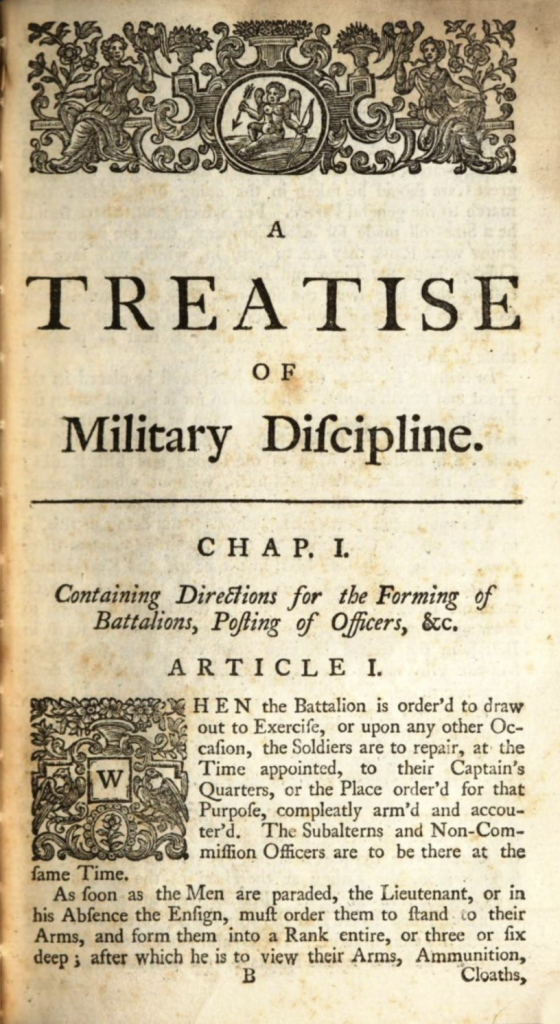
Dr. Carl Ekberg called Winchester Washington’s classroom and “Humphrey Bland’s Treatise of Military Discipline (London, many editions) […] his master textbook.” This particular book, coupled with Washington’s defeat at Fort Necessity, paints a picture of a young Colonel trying to protect the colonists on Virginia’s frontier while making a name for himself in the Virginia Militia by building a strong fort and training a strong army.
Note: You can read a digital copy of Bland’s Treatise of Military Discipline on Google Books.
Washington was incredibly disciplined and determined, which comes through in his correspondences, like in a letter he wrote to Dinwiddie from Winchester on May 23, 1756, in which he says he has to stay and oversee the fort’s construction or it won’t get done:
At this place I have begun the Fort according to your Orders; and found, as little of the matter as I know myself, the work could not be conducted if I was away: which was one among many reasons, that detained me here.
Dinwiddie from Winchester on May 23, 1756 10
This discipline gained him respect and honor, which is evident in how highly everyone spoke of him and how much everyone trusted Washington’s opinions:
The building the Forts in proper Places must be left to You, as You know the Situation of the Country, so fix them in Places most convenient & necessary for our Protection; and the Form of the Forts must be agreeable to the SItuation of the Ground, & the Distance from each must be from Yr own Judgement; I am of Opinion 100 Men shou’d be appointed to each Fort, & a Detachmt of 50 or sixty from each to way-lay & watch the Enemy’s coming over the Mounts., at proper Places to attack them will answer better than hunting for them, as they are so well acquainted with the Woods they will always disappoint any such Attempts; whereas if they are surpriz’d in their March it’s probable it may be of more Service.”
From Robert Dinwiddie, Williamsburg, June 12th 1756 11
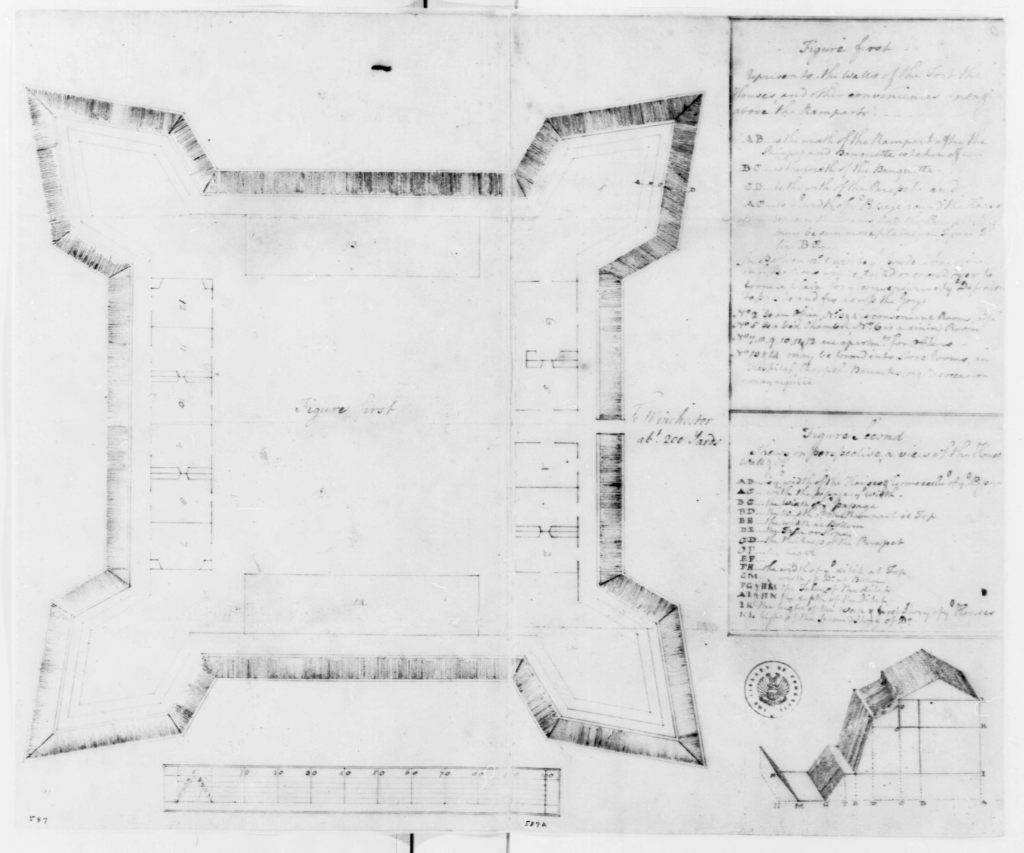
So Washington got to work, designing and building Fort Loudoun. He created a couple of designs, ultimately settling on the one pictured below, which you can see in greater detail on the Library of Congress website.
I am also detained here to construct and erect a fort, which the Governor has ordered to be done with expedition – As it will be necessary to have a number of Carpenters, &c to carry on the work with spirit, and vigour; you are desired to send down all the men of Captain George Mercers Company; those that are there of Captain (David) Bells – all the men that are really skilled in masonry; and if all these do not make up fifty – you are to complete the party to that number, out of the best Carpenters in other Companies…
Washington to Lt. Col. Adam Stephen, on May 18, 1756 13
Washington bought Inlot No 77 and brought his own blacksmith from Mount Vernon to work at the blacksmith shop he built on the property to supply ironwork during the fort’s construction. We can see the discipline showcased as Washington does everything he can to make Fort Loudoun a success, but he faced a lot of challenges, in large part because he was responsible for training the men to be soldiers as well as contractors. He drafted orders on June 1, 1756 that said,
The Company of artificers being intended to assist in building a Fort at this place, are to do no Duty as Soldiers—They are to get their Tools in order, and go to work to-morrow morning. A Return to be given in immediately of all the men fit for Duty in Town; mentioning those who are good Carpenters.”
Orders, 1 June 1756 14
Why did Washington choose Winchester?
Winchester is now the farthest boundary of this county,—no inhabitants beyond it: and if measures are not taken to maintain it, we must retire below the Blue Ridge in a very short time.
George Washington to John Robinson, 27 April 1756 15
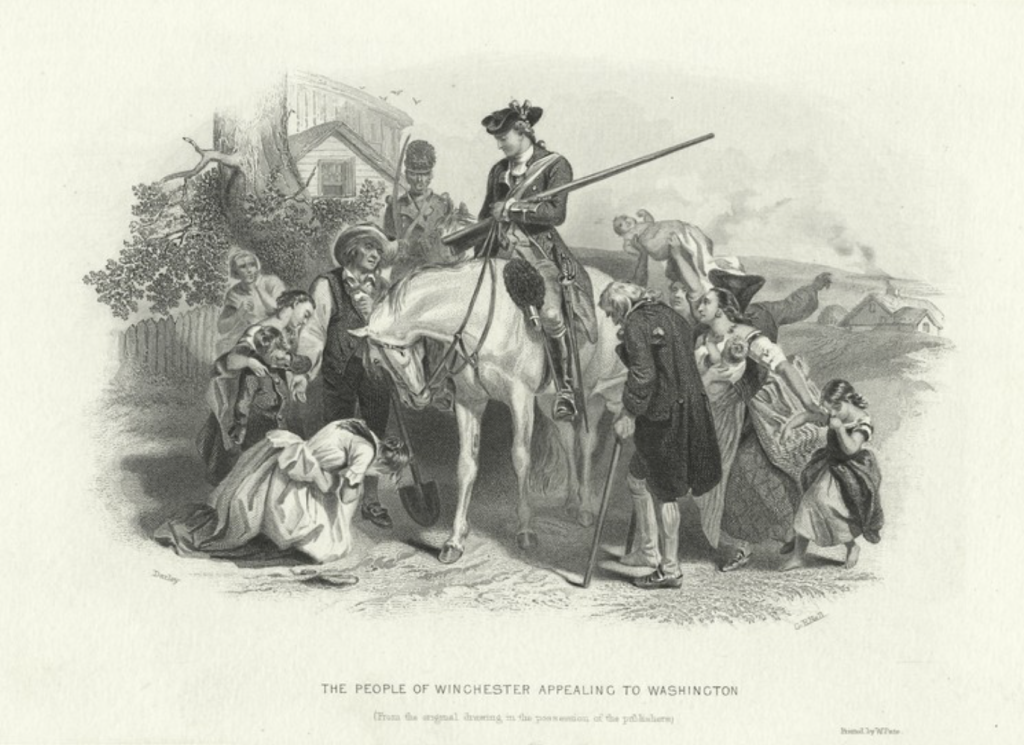
The Shenandoah Valley was sparsely populated in the 1700s, and particularly in the central region where Winchester (known as Frederick Town at the time) was the only town, founded in 1744 by James Wood. Dr. Carl Eckberg explains, “Winchester was the largest settlement in the Shenandoah Valley in 1754, and it was geographically oriented for settler expansion westward, into and over the mountains.” 17
It’s important to understand that this central part of the Shenandoah Valley was truly the frontier, far from the protection of major cities, so settlers were vulnerable to attack from French and Indian war parties. Colonel Washington knew this region’s vulnerability and advocated for a large fort to be built in Winchester as a sanctuary for its townspeople.
The Virginia House of Burgesses voted to build a chain of forts to protect the Virginia frontier. Stretching approximately 250 miles, it proposed fourteen forts garrisoned with 700 men. Washington promoted Winchester as the location for a large magazine to supply the diverse forts planned along the frontier.
| Pause to explore! Jim Moyer is a historian and member of the French & Indian War Foundation. He created and maintains a Google map that has frontier forts pinned and annotated with historical information. For more information on the frontier forts that he has researched, visit his website here. On 9 November 1756, Washington wrote a proposal for 22 frontier forts with 2000 men garrisoned across them. He writes, A Plan of the number of Forts, and strength necessary to each, extending entirely across our Frontiers, from South to north.18 In his proposal, Washington plans for Fort Loudoun to garrison 100 men. |
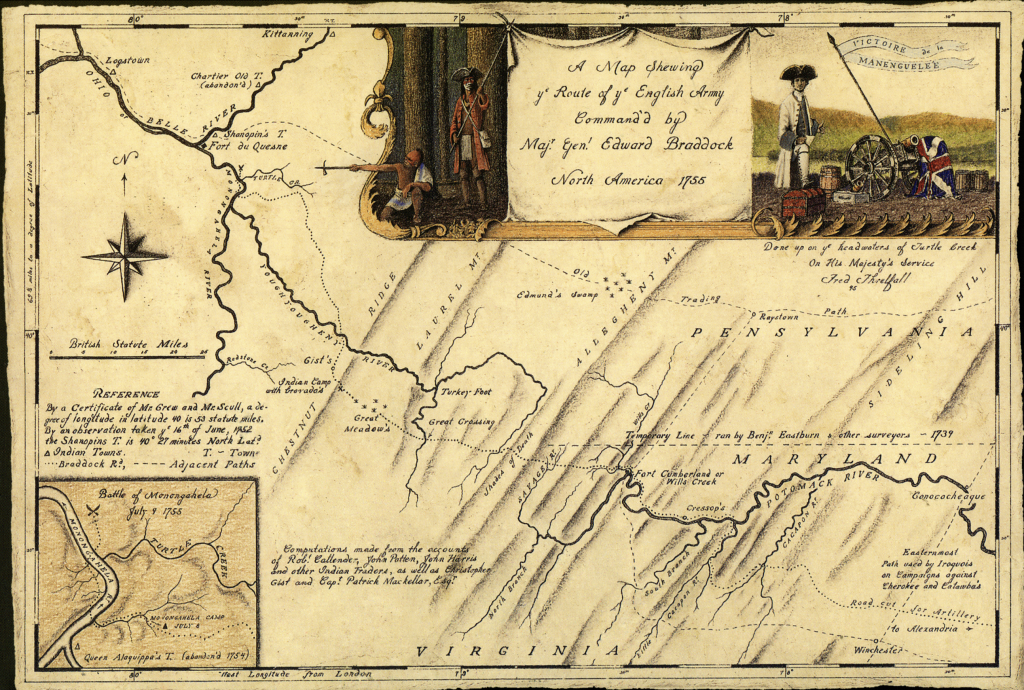
Winchester was a small town with only about sixty cabins, but it stood at an important crossroad: the Great Wagon Road (also called the Old Indian Road) that ran through the Shenandoah Valley to Philadelphia. Several roads ran east, across the mountain gaps, leading to Alexandria, Virginia and Williamsburg, Virginia. There was also the newly cut Braddock’s Road that ran west to Fort Duquesne.
It was a convenient location for gathering intelligence from the frontier, providing supply routes from Alexandria and Philadelphia, and ensuring safe access to the colonial government in Williamsburg.
- Straub, S. (2022, July 17). Tour of Fort Loudoun, Winchester, VA Rev7.17.22. YouTube. https://youtu.be/ChevGypmBaM?si=I428TRIr6H8qI34O ↩︎
- “From George Washington to Robert Dinwiddie, 7 April 1756,” Founders Online, National Archives, https://founders.archives.gov/documents/Washington/02-02-02-0332-0001. [Original source: The Papers of George Washington, Colonial Series, vol. 2, 14 August 1755 – 15 April 1756, ed. W. W. Abbot. Charlottesville: University Press of Virginia, 1983, pp. 332–336.] ↩︎
- “From George Washington to Robert Dinwiddie, 24 April 1756,” Founders Online, National Archives, https://founders.archives.gov/documents/Washington/02-03-02-0044. [Original source: The Papers of George Washington, Colonial Series, vol. 3, 16 April 1756–9 November 1756, ed. W. W. Abbot. Charlottesville: University Press of Virginia, 1984, pp. 44–47.] ↩︎
- Washington, G. (1755) George Washington Papers, Series 2, Letterbooks 1754 to 1799: Letterbook 3,- Sept. 18, 1756. – September 18, 1756. [Manuscript/Mixed Material] Retrieved from the Library of Congress, https://www.loc.gov/item/mgw2.003/. ↩︎
- Baker, N. L. (2006). Fort Loudoun: Washington’s Fort in Virginia. ImPRESSions PLUS. ↩︎
- Washington, G. (1755) George Washington Papers, Series 2, Letterbooks 1754 to 1799: Letterbook 3,- Sept. 18, 1756. – September 18, 1756. [Manuscript/Mixed Material] Retrieved from the Library of Congress, https://www.loc.gov/item/mgw2.003/. ↩︎
- “To George Washington from Robert Dinwiddie, 27 May 1756,” Founders Online, National Archives, https://founders.archives.gov/documents/Washington/02-03-02-0180. [Original source: The Papers of George Washington, Colonial Series, vol. 3, 16 April 1756–9 November 1756, ed. W. W. Abbot. Charlottesville: University Press of Virginia, 1984, pp. 178–182.] ↩︎
- “To George Washington from Robert Dinwiddie, 3 May 1756,” Founders Online, National Archives, https://founders.archives.gov/documents/Washington/02-03-02-0076. [Original source: The Papers of George Washington, Colonial Series, vol. 3, 16 April 1756–9 November 1756, ed. W. W. Abbot. Charlottesville: University Press of Virginia, 1984, pp. 85–87.] ↩︎
- Bland, H. (1734). A treatise of military discipline in which is laid down and explained the duty of the officer and soldier, … by Humphrey Bland, .. printed for Sam. Buckley; and sold by James, John and Paul Knapton; Dan Midwinter; and John Osborn and Tho. Longman. ↩︎
- “From George Washington to Robert Dinwiddie, 23 May 1756,” Founders Online, National Archives, https://founders.archives.gov/documents/Washington/02-03-02-0169. [Original source: The Papers of George Washington, Colonial Series, vol. 3, 16 April 1756–9 November 1756, ed. W. W. Abbot. Charlottesville: University Press of Virginia, 1984, pp. 171–174.] ↩︎
- “To George Washington from Robert Dinwiddie, 12 June 1756,” Founders Online, National Archives, https://founders.archives.gov/documents/Washington/02-03-02-0200. [Original source: The Papers of George Washington, Colonial Series, vol. 3, 16 April 1756–9 November 1756, ed. W. W. Abbot. Charlottesville: University Press of Virginia, 1984, pp. 199–202.] ↩︎
- (1756) George Washington Papers, Series 4, General Correspondence: George Washington, Diagrams of Frontier Forts. [Manuscript/Mixed Material] Retrieved from the Library of Congress, https://www.loc.gov/item/mgw442497/. ↩︎
- “From George Washington to Adam Stephen, 18 May 1756,” Founders Online, National Archives, https://founders.archives.gov/documents/Washington/02-03-02-0158. [Original source: The Papers of George Washington, Colonial Series, vol. 3, 16 April 1756–9 November 1756, ed. W. W. Abbot. Charlottesville: University Press of Virginia, 1984, pp. 157–163.] ↩︎
- “Orders, 1 June 1756,” Founders Online, National Archives, https://founders.archives.gov/documents/Washington/02-03-02-0186. [Original source: The Papers of George Washington, Colonial Series, vol. 3, 16 April 1756–9 November 1756, ed. W. W. Abbot. Charlottesville: University Press of Virginia, 1984, pp. 188–189.] ↩︎
- Washington, G. (1755) George Washington Papers, Series 2, Letterbooks 1754 to 1799: Letterbook 3,- Sept. 18, 1756. – September 18, 1756. [Manuscript/Mixed Material] Retrieved from the Library of Congress, https://www.loc.gov/item/mgw2.003/. ↩︎
- The Miriam and Ira D. Wallach Division of Art, Prints and Photographs: Print Collection, The New York Public Library. The people of Winchester appealing to Washington. Retrieved from https://digitalcollections.nypl.org/items/510d47db-9e54-a3d9-e040-e00a18064a99 ↩︎
- Eckberg, C. (2020). The French & Indian War Foundation. Retrieved from https://fiwf.org/wp-content/uploads/2021/09/FIWF-Newsletter_V15No5-SpecialEdition_2020.pdf. ↩︎
- Threlfall, F. (n.d.). 1755 Map of Braddock’s Road. Explorepahistory.com. https://explorepahistory.com/displayimage.php?imgId=1-2-8D0 ↩︎

This exhibit was made possible, in part, by a grant from the VA250 Commission in partnership with Virginia Humanities.

Exhibit researched and written by Jess Pritchard-Ritter, Donna Leight, and David Grosso. Created by For the Love of History Consulting, LLC.