
Researched and written by Donna Leight, 2025
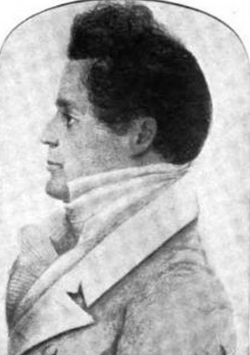
From Parkins to Rutherford
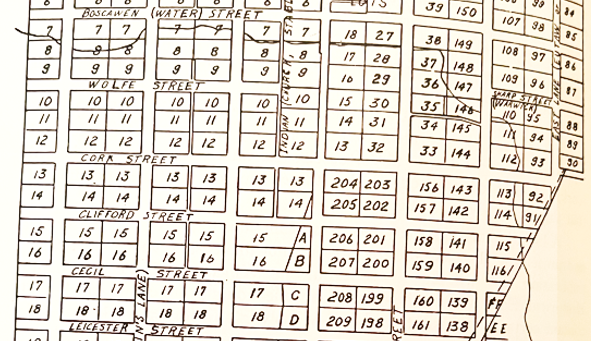
Robert Rutherford purchased Outlot 49 from Isaac Parkins in November 1764, on which Fort Loudoun stood. He would own the property for the next twenty years.1
It was a familiar place for Robert. He knew George Washington from the French and Indian War, where he had served as a deputy commissary for the Virginia forces from 1755 to 1757. He was a captain of a Virginia ranger company known as Rutherford’s Rangers, from 1757 to 1758. They had done survey work together.
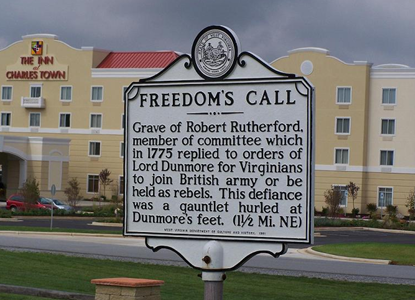
Rutherford went on to become a member of the Virginia House of Burgesses (1766–72) and attended all five Virginia Conventions (1774–76) where they declared that Virginians were ready to defend themselves “against every species of despotism.” He became a Virginia State Senator (1776–91), and a member of the U.S. House of Representatives (1793–97). In winning his election to the U.S. Congress, he became the first member from beyond the Blue Ridge mountains, where he was known for his patriotic speeches.2
Who Was Robert “Robin” Rutherford?
Robert Rutherford (1728–1803)was born in Scotland and came to America when young. In September 1753, he married Mary Howe, “the widow of Honorable George Augustus Howe, who was killed at the 1758 Battle of Ticonderoga.” Howe was the brother of Lord Admiral Howe of the British navy. Robert and Mary would have 9 children.
During the time Rutherford owned Outlot 49, from 1764-1785, the fort was in decline. Citizens of Winchester slowly dismantled the walls and used the timbers to build other structures in the growing town. The barracks remained and were used for various purposes until they too were dismantled. It was a prominent location, and “Fort Hill” would become a meeting point for travelers for many years.
During the Revolutionary War, some Hessian and British prisoners were kept in Charlottesville, Virginia. Colonel James Wood moved groups of these prisoners northward. Some were housed in the Fort Loudoun barracks, while others were held at barracks north of town.3 In 1777, Captain Andreas Wiederhold, a Hessian soldier and prisoner captured during the Battle of Trenton, drew a map of Winchester, which provides invaluable insight to historians today.
Following the death of James Wood in 1759, his wife Mary, conveyed much of her Winchester properties. In 1765, she conveyed a tract of land to her brother Robert Rutherford that today is roughly bound by Loudoun, Cork, Braddock, and Cecil Streets. It is thought that Robert built and lived in the house that now stands at 217 S. Loudoun Street. In 1791, he sold a section of this tract to hatter Abraham Lauck, brother of gunmakers Simon and Peter Lauck. Rutherford would later leave Winchester and move to his home, “Flowering Springs”, near Charles Town, WV.4
Robert was a close friend of George Washington, who in personal correspondence to Rutherford addressed him familiarly as “my dear Robin.”5 He assisted Washington as a surveyor and was living in Winchester as early as 1752 and when Braddock’s troops were on their way to Fort Duquesne in 1755. There is a great deal of correspondence between Rutherford and Washington, George Mercer, and others, that can be found on Founders Online. 6
In the article appearing in the West Virginia Historical Magazine of October 1901, it is said “Robert Rutherford was a devoted friend of Washington, and in defending him before Congress in 1794 made the following remark “As to the character of the President himself, to praise him was like holding up a rush candle to let us see the sun. I have known that man for these forty years. I had the honor of serving under him in the last war and of frequently executing his wise and noble orders.“7
Robert was said to be “eccentric, but brilliant and very popular”. He was a “plain, unassuming man, who dressed in the simplest garb, and very few would suspect the intelligence and ability that lurked beneath his homely clothing, while his integrity and kindness of heart were known to all.” 8
Notable facts about Robert Rutherford include the following.
- He was assigned as Deputy Sheriff in 1744.9
- He started the first store in Winchester VA, according to Kercheval’s History of the Valley of Virginia sometime prior to 1754.10
- He became Captain of a Ranger company in 1757 at the request of Gov Dinwiddie. The company was known as “Rutherford’s Rangers.”
- He was James Wood’s brother-in-law. Robert’s sister, Mary, married James Wood the founder of Winchester, VA.
- He was part of the General Assembly, along with James Wood and Capt. John Hite, as commissioners for Frederick County to settle the accounts of troops for their services in the “Colonial Wars” (Indian Wars), to persons for damages done by the Indians, and for supplies furnished the Continental Line Soldiers. This process started in 1759, but James Wood died, and the matter was not addressed until 1788.11
- He was involved in the formation of area towns.Appointed as a trustee for Winchester and Stephensburg (now Stephens City), along with Isaac Parkins (see previous story), James Wood, Lewis Stephens, Lord Fairfax, Thomas Bryan Martin, and others when Stephensburg was founded in 1758 (2nd town chartered in the Shen Valley). Part of the General Assembly that established the town of Bath in 1776, at the Warm Springs tract, in Berkeley, along with his brother Thomas, Bryan Fairfax, Thomas Bryan Martin, Warner Washington, Samuel Washington, Van Swearingen, Thomas Hite and others.12
- This is now the town of Berkeley Springs and is noted as “Medicinal Springs” on the Fry-Jefferson map of 1751.
When he ran for Congress in 1797, he ran against General Daniel Morgan and defeated him, but in 1799 Morgan defeated Rutherford. Norris tells a story about these rivals:15
“Gen. Morgan went to a prominent gentleman who he knew to be a warm friend of his, and asked him to not only vote for him, but to use his influence for him and against Mr. Rutherford. The gentleman took the old war-scarred hero by the hand, and looking into those eyes that never quailed before an enemy, said with much feeling: “General Morgan, you know me, and know that I never have and never will, deceive any man. Should a war break out and were I to have the selection of a commander-in-chief, there is no man in this wide world to whom I would give the place in preference to yourself; but, sir, when I am to select a member of Congress, then I must vote for Mr. Rutherford.”
Both the West Virginia Historical Magazine article and Norris tell an amusing story. While not authenticated, is most likely based on truth and reflects the personality of this interesting man:
“While he was a man of high character, of education, and refined feelings of great kindness of heart, and generous to a fault, he was very inattentive to fashion and always dressed in a very simple style. During his service as a member of Congress in Philadelphia, he was invited to dine with a prominent citizen of that city. Near the appointed hour, he presented himself, probably in homespun clothing, at the residence of his friend. Not giving his name at the door, he was not recognized and was requested to wait for the gentleman of the house, who was soon expected. Not being invited into the house, on account of the plainness of his appearance, Mr. Rutherford, who greatly enjoyed a piece of fun, took a seat quietly on the doorstep. After a short time, the lady of the house noticed him and still not knowing him, and supposing him to be tired and in need, said kindly she would give him his dinner if he would come in and cut some wood and bring some water she wanted. Mr. Rutherford readily assented and, after doing what she asked of him, took a seat in the corner of the kitchen to wait for the promised dinner.
Meanwhile, the gentleman of the house was wondering at the non-appearance of the honorable member of Congress from Virginia. Upon inquiring if anyone had called and asked for him, he was told that no one had done so, except an old man who was then in the kitchen, waiting to see him on business. Mr. Rutherford was soon forthcoming. The hostess was of course mortified at her mistake, but was soon put at ease by Mr. Rutherford, who was greatly amused and not at all offended, and the dinner passed off nicely but not in the kitchen.”
In 1801, Robert’s compassionate character was on display when he appeared before the Jefferson County justices and manumitted his slaves, Menta, Joseph, and Adam. This was a first case of manumission in that county. “Numbers of other cases occurred similar to that, of plain old ‘Robin’ Rutherford, whose heart is said to have been far out of proportion to his frame.” 16
Patriot Robert Rutherford died in 1803 (or 1805) at his handsome estate, “Flowing Springs”, near Charlestown, West Virginia. He left his estate to his wife, Mary. They are buried at “Flowing Springs”.
Thomas “Hugh” Rutherford (Robert’s Father, 1695-1768)
Robert’s father, Thomas “Hugh” Rutherford was an early and important resident of Frederick County.
On Nov 11, 1743, the first court was held for Frederick County and documented in Order Book No. 1, 1743, in the handwriting of James Wood. Thomas “Hugh” Rutherford and five other men were administered the oath of Justice of the Peace, under the hand of the Honorable William Gooch, Esq., His Majesties Lieutenant Governor and Commander in Chief of the Colony and Dominion of Virginia. James Wood was sworn in as the Clerk, Thomas Rutherford as the High Sheriff, and George Home as the County Surveyor.17 This made Hugh Rutherford the first Sheriff of Frederick County Virginia, 1743-1745.18
Hugh Rutherford had multiple early “minor” land grants including land adjoining Major Lawrence Washington. His Frederick County plantation adjoined James Wood’s plantation, near Winchester VA.19 Hugh later moved to Berkeley County, once it was formed.
Thomas Rutherford (Robert’s Brother, 1729-1804)
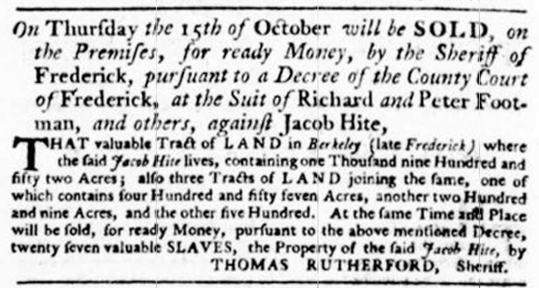
Robert’s brother, Thomas Rutherford, was also well known to Washington, having served as a Virginia ranger officer, Indian agent, and deputy commissary during the French & Indian War.20
Thomas Rutherford was lieutenant of John Ashby’s 2nd company of rangers. Washington recommended him to Dinwiddie for an ensign’s commission in the Virginia Regiment in June 1757, but instead Dinwiddie appointed him Indian agent to conduct the Catawba Indians to British forts on the western frontier. Thomas served as an Indian agent under Christopher Gist from July 1757 until the fall of 1758, when he became deputy to Commissary Thomas Walker. In 1761 he was elected a burgess for Hampshire County, and he served continuously in the Virginia Assembly until 1769.21
Like his father, Thomas served as the Sheriff of Frederick County. His name, as well as his brother Robert’s name can be found in many old newspaper notices.
Thomas owned and lived on Lot 12 in Winchester. In 1764, Mary Wood, his sister and widow of James Wood, conveyed land to Thomas on the east side of Braddock Street, south of Lot 12. Thomas’ property included what is now George Washington’s Headquarters at the corner of Cork and Braddock Streets.22
Robert & Mary Rutherford’s Children
Robert’s oldest daughter, Susan (Susannah), married Colonel John Peyton, who would buy Outlot 49 in 1785. The Peyton ownership will be discussed in the next story. Daughter Mary married Major Henry Peyton, then married Colonel John Morrow. Daughter Deborah married Colonel George Hite, grandson of Yost Hite. Their only son, Thomas Hugh, died at age 19.
It is worth noting that oil portraits of Robert and Mary Rutherford hung in his daughter Susan’s house at 406 North Loudoun Street. Per Katherine Glass Green, during the Civil War, the house was occupied by northern soldiers, and the oil paintings were destroyed. 23
- Frederick County Virginia Deed Book 10, Page 45 ↩︎
- Conrade, Mary Louise and Craighill, Gen W.P. The Rutherfords. The West Virginia Historical Magazine Quarterly, October 1901. Charleston, W.VA. Published by the West Virginia Historical and Antiquarian Society. Donnally Publishing Company. ↩︎
- Green, Katherine Glass Greene. Winchester Viriginia an Its Beginnings 1743-1814. Shenandoah Publishing House, Strasburg, VA. 1926 ↩︎
- Quarles, Garland R. The Story of One Hundred Old Homes in Winchester, Virginia. Prepared for the Farmers and Merchants National Bank, Winchester, Virginia 1967 ↩︎
- Conrade, Mary Louise and Craighill, Gen W.P. The Rutherfords. The West Virginia Historical Magazine Quarterly, October 1901. Charleston, W.VA. Published by the West Virginia Historical and Antiquarian Society. Donnally Publishing Company. ↩︎
- Founders Online, https://founders.archives.gov, National Archives and Records Administration ↩︎
- Conrade, Mary Louise and Craighill, Gen W.P. The Rutherfords. The West Virginia Historical Magazine Quarterly, October 1901. Charleston, W.VA. Published by the West Virginia Historical and Antiquarian Society. Donnally Publishing Company. ↩︎
- Norris, J.E. History of the Lower Shenandoah Valley, Counties of Frederick, Berkeley, Jefferson, and Clarke. A. Warner & Co., Publishers, 1890, Classic Reprint Series by Forgotten Books ↩︎
- Cartmell, T.K. Shenandoah Valley Pioneers and Their Descendants: A History of Frederick County, Virginia, From its Formation in 1738 to 1908. The Eddy Press Corporation, Winchester, VA 1909 ↩︎
- Kercheval, Samuel. A History of the Valley of Virginia. 4th Ed. Strasburg Publishing House, Strasburg, VA. 1925 ↩︎
- Cartmell, T.K. Shenandoah Valley Pioneers and Their Descendants: A History of Frederick County, Virginia, From its Formation in 1738 to 1908. The Eddy Press Corporation, Winchester, VA 1909 ↩︎
- Ibid. ↩︎
- Ibid. ↩︎
- Kercheval, Samuel. A History of the Valley of Virginia. 4th Ed. Strasburg Publishing House, Strasburg, VA. 1925 ↩︎
- Norris, J.E. History of the Lower Shenandoah Valley, Counties of Frederick, Berkeley, Jefferson, and Clarke. A. Warner & Co., Publishers, 1890, Classic Reprint Series by Forgotten Books ↩︎
- Ibid. ↩︎
- Cartmell, T.K. Shenandoah Valley Pioneers and Their Descendants: A History of Frederick County, Virginia, From its Formation in 1738 to 1908. The Eddy Press Corporation, Winchester, VA 1909 ↩︎
- List of Sheriffs | Frederick County https://www.fcva.us/departments/sheriff-s-office/archives/list-of-sheriffs ↩︎
- Green, Katherine Glass Greene. Winchester Viriginia an Its Beginnings 1743-1814. Shenandoah Publishing House, Strasburg, VA. 1926 ↩︎
- Kercheval, Samuel. A History of the Valley of Virginia. 4th Ed. Strasburg Publishing House, Strasburg, VA. 1925 ↩︎
- Ibid. ↩︎
- Quarles, Garland R. The Story of One Hundred Old Homes in Winchester, Virginia. Prepared for the Farmers and Merchants National Bank, Winchester, Virginia 1967 ↩︎
- Green, Katherine Glass Greene. Winchester Viriginia an Its Beginnings 1743-1814. Shenandoah Publishing House, Strasburg, VA. 1926 ↩︎
- Russell, William Greenway. What I Know About Winchester: Recollections of William Greenway Russell, 1800-1891. The Winchester-Frederick County Historical Society, 1953. ↩︎