
Researched and written by Donna Leight, 2025
From Forested Land to Lord Fairfax to Isaac Parkins
Prior to settlement, the northern Shenandoah Valley was a forested expanse visited by various Native American tribes. Only a small band of Shawnee lived in the region (1690 to early 1754) during initial white settlement in the 1730s. Land grants were assigned to men like Jost Hite (1731), Abraham Hollingsworth (1732), Isaac Parkins (1735), and James Wood (1738). Small farms began forming in the area.
James Wood wanted to start a town and lay out its lots, but he was in Fairfax territory and had to use caution. He sought permission to set aside a portion of his land west of Opequon Run, for a county seat, in March of 1744. The request was to lay out 26 lots, one-half acre each, with two streets running through the lots, on land owned by Wood. Politics were in play between Wood and Fairfax over this plan, but Wood persevered and finally chartered the town in 1752. By then, Fairfax had added 54 lots of his own, for a total of 80 Winchester lots.
These 80 were called “inlots” or house lots. Buyers were required to erect a house within two years of purchase. The house was to be of squared, dovetailed logs, and at least 16 x 20 feet in size. Each inlot included an “outlot” of 3 to 5 acres, located on the north and south ends of town, to be used for gardening and pasturage. They were often referred to as the “commons”.
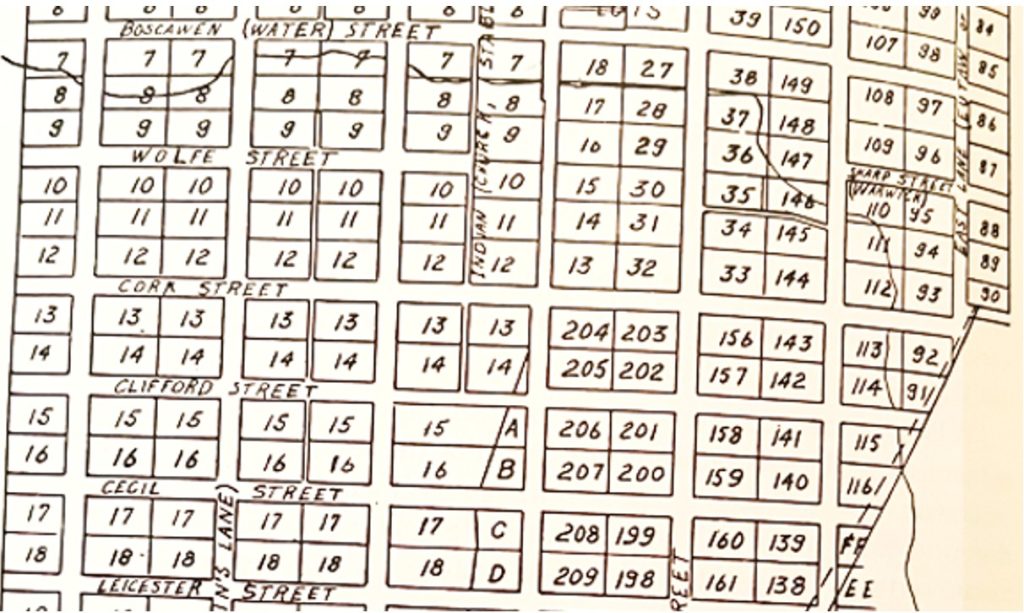
Records show that Lord Fairfax sold 439 acres to Isaac Parkins in May 1753, which included inlot 32 and outlot 49. Outlot 49 would later hold the majority of Fort Loudoun and the current French & Indian War Foundation headquarters at 419 N. Loudoun Street. Parkins would later sell the same property to Robert Rutherford. From the Frederick County Deed Book:
“…This Indenture made the 7th day of November in the year of 1764 Between Isaac Parkins of the County of Frederick, of the one part, and Robert Rutherford of the said county of the other part, Witnessed that the said Isaac Parkins for and in consideration of the sum of Five Shillings current money of Virginia to him in hand paid by the said Robert Rutherford at or before the sealing and deliver of these Presents the Receipt whereof is hereby acknowledged, Hath Granted, Bargained, and Sold and by these Presents, Doth Grant Bargain and Sell unto the said Robert Rutherford One Lott of half acre of land situate lying and being in the Town of Winchester in the said Country known by the Number (32) also one other Lott or Tract of Land containing five acres known by the Number (49) situate in the County and Contiguous to the said Town being Part of and included in a Tract containing Four Hundred Thirty Nine acres which said Lotts were granted to the said Isaac Parkins by Deed under the Hand and Seal of the Right Honorable Thomas Lord Fairfax, Proprietor, bearing Date the Fifteenth Day of May 1753…” 1
Early records show that Isaac Parkins also purchased inlot 15 and outlot 22 and may have owned inlot 13 and outlot 65.2 3 It is not known what structures Parkins built on his Winchester inlots at that time, but we do know that Fort Loudoun consumed much of Parkins’ Outlot 49.
The French & Indian War technically started in 1754 with events at Jumonville and Fort Necessity, with the formal declaration of war between England and France in 1756. It ended with the signing of the Treaty of Paris in February 1763. The war extended beyond the American colonies and was known around the globe as the Seven Year War. In Virginia, approval of a large fort was authorized to protect Virginia’s western frontier, and Winchester’s “North Common” hill was selected as the prime location. Construction started in May 1756 and continued through 1758. The massive structure dominated the north end of Winchester, and the area was thereafter called Fort Hill.
Fort Loudoun’s presence greatly impacted early Winchester. Much is written about Winchester’s fort and the French & Indian War, but very little is known about the man that owned the property throughout that war, selling it in November 1764 to Robert Rutherford. (We’ll talk about the Rutherford in another story.)
Who Was Isaac Parkins?
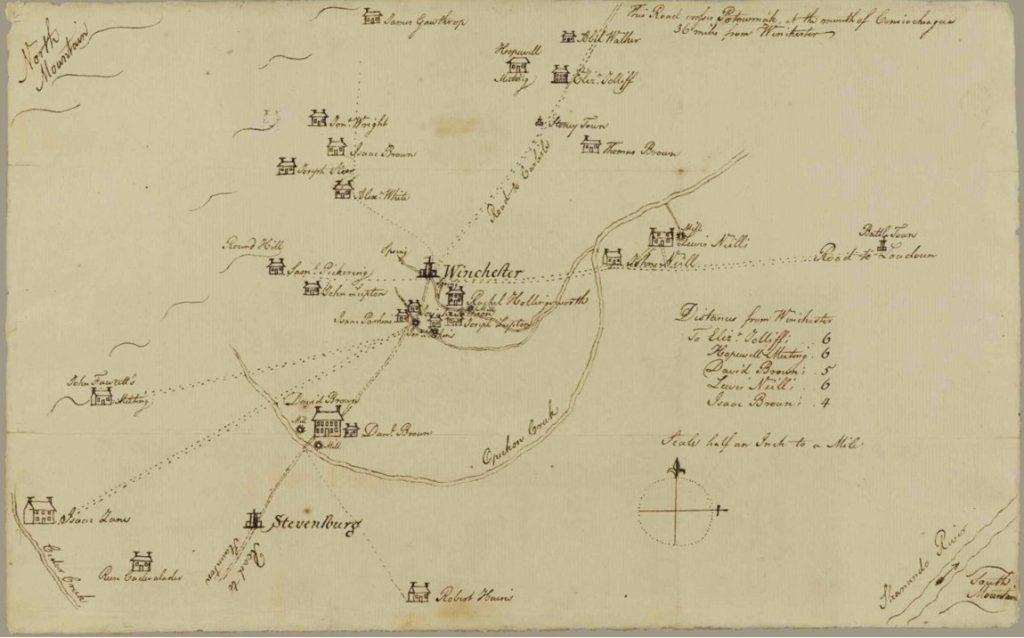
Isaac Parkins (1697-1773) was one of the first settlers in the Shenandoah Valley. In November 1735, he received a Royal patent for 750 acres of land south of Winchester. He built a home, a mill, and other outbuildings, along Abrams Creek on the Wagon Road (now Valley Avenue). He also had additional grants from Lord Fairfax.
Upon his arrival, he would have found a small Shawnee Indian village near his property, at springs that fed Abrams Creek (today known as the Shawnee Springs Preserve). The Shawnee remained there until 1754, and Parkins undoubtedly interfaced with them. However, no records of this exchange have been found by the author.
Per Garland Quarles, “Isaac Parkins was a leader of the Society of Friends and an influential citizen of Frederick County, serving as a justice, a captain of militia, and a vestryman. He also represented the County as a member of the Virginia House of Burgesses in 1754-1755.” 6 7
The first Quaker meetings for worship were held in the Parkins and Abraham Hollingsworth homes. The first Quaker marriage in the Valley took place in Parkins’ home near Abram’s creek, in December 1734.
Though Parkins was Quaker, “the Episcopal church in Colonial days was the established church of the colonial Government and according to the old English law, the vestries of the Episcopal congregations had certain governmental functions, the result of which was that wherever the Government was established, the church was also established. This establishment was made in Winchester in 1738… The first Church building stood on the Southwest corner of the public square at Main and Water streets where a log-chapel was erected about the year 1740 or 1742.” The list of the vestry included Isaac Parkins, along with Lord Fairfax, John Hite, and Thomas Swearingen. 8
Parkins was listed as a Captain in the Frederick Co. Militia in George Washington’s ledger. Per Kercheval, Fairfax wrote, “At a council of war, held for regulating the militia of Frederick county, in order to take such steps as shall be thought most expedient in the present critical conjuncture, the 14th day of April 1756: present, the Rt. Hon. the Lord Fairfax, county lieutenant; John Hite, major; John, Lindsey, Isaac Parkins, Richard Morgan, Samuel Odell, Edward Rodgers, Jeremiah Smith, Thomas Caton, Paul Long, captains.” 9
Wheat from George Washington’s Bullskin plantation (east of present-day Summit Point WV) was processed at Parkins’ mill per correspondence from 1758. The flour was then sold to various people, including William Ramsay who was buying flour for the Virginia troops at Fort Loudoun. Letters to Washington from Lieutenant Charles Smith, commander at Fort Loudoun, and Christopher Hardwick, Washington’s Bullskin plantation overseer, document an accounting dispute over a wheat/flour that went through Parkins’ mill. 10
The name Isaac Parkins and Isaac Perkins are both found throughout local historical documents. They are the same person. We have used Parkins in this article, unless quoting a specific resource.
Isaac and Grace Parkins’ Children
Based on this author’s research, Isaac was born in New Hampshire in 1697. He moved to Pennsylvania where he met Mary “Grace” Booth, who was from Delaware. They were married in 1723, moved to Winchester, and started a family. The Quaker Meeting Records for the Hopewell Meeting House, 1681- 1935, show that Isaac and Mary Parkins had 14 children. Other records show 18. In either case, their children contributed to the Parkins legacy in the Winchester area. For example, Parkins Mill Road off of Rt 522 was so named due to the mills along Opequon Creek, on the property once owned by great-grandson Alfred Parkins.
Over the years, his children acquired much of his land. Court records show 500 acres went to his son Charles in 1752. This Opequon land was part of 2 tracts granted by Gov. Gooch in 1735 and Lord Faifax in 1751. Isaac also sold 137 acres, west of the “Waggon Road” to his son Jonathan in 1754. According to a will found by this author, he left most of his real and personal estate to his wife “Grace”, including his slaves. He left his set of smith tools to his grandson John Barret.
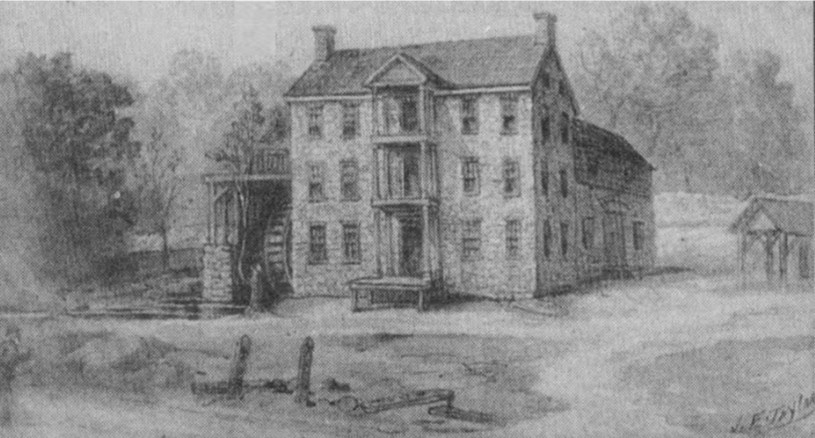
In 1799, Parkin’s granddaughter Hanna, married Isaac Hollingsworth, son of Zebidee Hollingsworth.11 In 1827, Hollingsworth replaced the Parkins mill on Abrams Creek with an impressive 3-story stone mill, that was operated and later owned by Festus Hahn. The area, south of Winchester on the “Valley Pike” became known as the Milltown Mills. An 1809 map shows 11 mills along the creek.
In 1836, Hollingsworth built the magnificent brick mansion named “Willow Lawn”, in the Milltown Mills area. “Willow Lawn” was famous for many years in Winchester, including its public pool fed by the springs of Abrams Creek, open from 1947-1964. The home was torn down in 1964 and replaced with a car dealership (now Malloy Ford). Only one Milltown Mills house remains. “Montague Hall” still stands on Valley Avenue, built by miller Festus Hahn in 1873.12

Many of Parkins’ children and grandchildren are buried at Winchester’s Hollingsworth-Parkins Graveyard, along with other notable Quakers of the time, such as Abraham Hollingsworth and Sarah Zane.13
Isaac’s grandson, John Parkins, left the graveyard for the use of Quakers in 1815. His will, dated May 5th, 1815, states:
“I John Parkins being sick of Body but of sound understanding do make devise and direct in this my Last Will & Testament that that spot of ground called and known by the name of burying ground on my land wherein my parents and many others of our family have been Entered be kept and forever Reserved for the purpose of Burying Ground for the use and to be at the disposal of the Society of Friends in general...” 14
It is believed that Isaac Parkins died on May 9, 1773, at his Hoge Creek Plantation outside of Winchester Virginia.
- Proprietor’s Grants, Book M, Page 340 and Frederick County Virginia Deed Book, Number 10, Page 45. ↩︎
- Cartmell, T.K. Shenandoah Valley Pioneers and Their Descendants: A History of Frederick County, Virginia, From its Formation in 1738 to 1908. The Eddy Press Corporation, Winchester, VA 1909 ↩︎
- Morton, Frederic. The Story of Winchester in Virginia: The Oldest Town in the Shenandoah Valley. Heritage Books, 2007. ↩︎
- “What I Know About Winchester: Recollections of William Greenway Russell, 1800-1891” Reprinted from The Winchester News by The Winchester-Frederick County Historical Society, Excerpt of “Map Showing In-Lots, Winchester, Va.” ↩︎
- Map of Winchester by Thomas Fisher, 10 March 1777, Frederick Co., VA. Collection of the Historical Society of Pennsylvania, Logan-Fisher-Fox family papers, Acc. 5439, Philadelphia, PA. Source: mesdajournal.com. ↩︎
- Quarles, Garland R. Some Old Homes in Frederick County, Virginia. Prepared for the Farmers and Merchants National Bank, Winchester, Virginia 1971 ↩︎
- House of Delegates History (DOME), https://history.house.virginia.gov/ ↩︎
- Morton, Frederic. The Story of Winchester in Virginia: The Oldest Town in the Shenandoah Valley. Heritage Books, 2007. ↩︎
- Kercheval, Samuel. A History of the Valley of Virginia. 4th Ed. Strasburg Publishing House, Strasburg, VA. 1925 ↩︎
- Founders Online, https://founders.archives.gov, National Archives and Records Administration ↩︎
- Quarles, Garland R. Some Old Homes in Frederick County, Virginia. Prepared for the Farmers and Merchants National Bank, Winchester, Virginia 1971 ↩︎
- Van Meter, Val. Man’s Family History Travels Valley Pike. The Winchester Star, February 23, 2013. Found via the Newspaper Archive by Storied. https://access.newspaperarchive.com/us/virginia/winchester/winchester-star/2013/02-23/page-6 ↩︎
- FindAGrave.com ↩︎
- https://quaker.org/legacy/hopecentre/history/graveyard.html ↩︎