
There come up thirteen of the Nottaway Indians, and I recommend them to your care and direction: They may be serviceable with property management. I promised them a Jacket a-piece; which you must give them, if such things can be procured there – any other little necessaries may be ordered them – but take great care to keep them from liquor.
To Adam Stephen, Winchester, 18 May 1756 1
His Relationships with American Indians
George Washington’s entire life was intertwined with American Indians and the struggle over their western lands. He met American Indians on the frontier and in council. He fought beside them and he fought against them. He admired some and disliked many. He respected their skill in battle but struggled to appreciate their culture and values. He would wrestle with American Indian policies until his retirement at Mount Vernon in 1797.
The Early Years: 1732 to 1753
By the time Washington was born, Virginia had dispossessed the American Indians of the Virginia Tidewater region where he grew up, and the government was permitting traders and colonists to settle on American Indian lands further west. He met his first “wild” American Indian when he was 16-years-old at a trading post of Thomas Cresap along the Potomac River in Maryland. He didn’t think kindly of the Indians, nor the settlers he met there, saying the settlers were “as ignorant a set of people as the Indians.” 2
His impressions may seem harsh to us now, but we must consider his background. He was born into a family of means, at a time when a large portion of the population lived in poverty and servitude. He would always see the world through a lens of privilege and opportunity.
The French & Indian War Era: 1753 to 1759

Washington learned much about American Indians during his service in the French & Indian War. He was exposed to American Indian diplomacy, although he would not appreciate it until later in life. He realized the need for strong American Indian allies but often described them as unreliable, mercenaries, and savages, not to be trusted. He tried to command American Indian leaders, as he did his enslaved persons, rather than treating them as equals and allies.
Many Indian Nations would side with the French during the French & Indian War. The French offered trade but didn’t saturate their land with settlements. The British wanted trade, plus territory. British treaty terms were repeatedly broken. British colonists continued to take land beyond treaty boundaries. Land meant power and wealth, which Washington fully understood.
Strong American Indian alliances were important for the British but were difficult to maintain. A large Indian Council was held in Winchester Virginia in September of 1753. In 1757, a large group of Catawba and Cherokee allies came to Winchester’s Fort Loudoun.
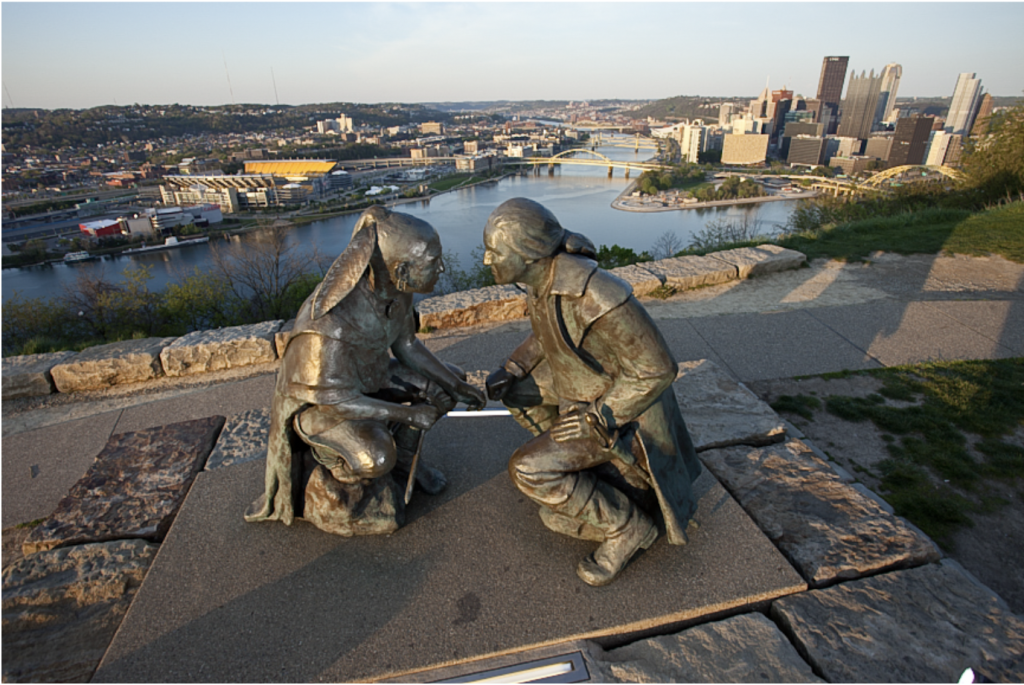
Much is written about Washington’s experience with American Indians early in his life including the Seneca’s Tanaghrisson (also called the Half King) and Guyasuta. Washington first met them in 1753 on his trek to Fort LeBoeuf with a message to the French regarding Great Britain’s claim to the Ohio country. The expedition left Williamsburg, Virginia with Washington, guide Christopher Gist, interpreter John Davison, Ohio Company employee Barnaby Currin, Delaware chief Shingas, and several others. In Logstown, Pennsylvania, they met Tanaghrisson and Guyasuta, and together they traveled to Fort LeBoeuf. The meeting with the French was complicated by Tanaghrisson’s side discussions and politics.
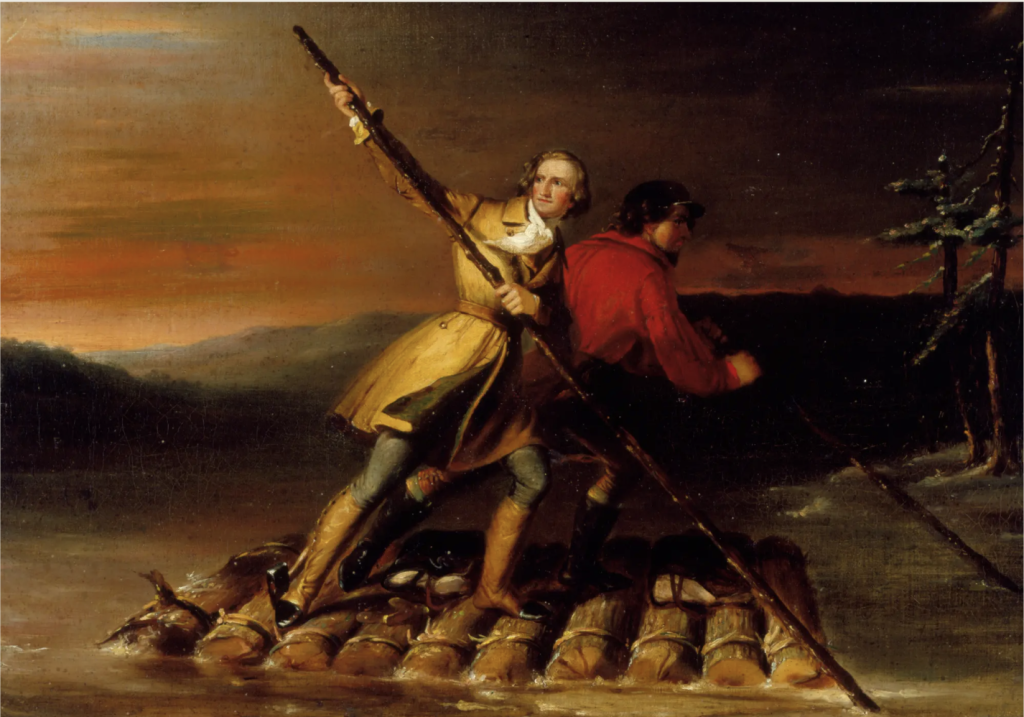
Although the trip didn’t go as well as hoped, Washington and his party left for Williamsburg to deliver the French letter to Governor Dinwiddie. The trip back, however, was treacherous with Washington falling into the frozen Allegheny River and being saved by Gist. Washington would write of the expedition,
I can’t say that ever in my Life I suffer’d so much Anxiety as I did in this Affair.
George Washington 6
Washington would have another harrowing experience with Tanaghrisson the following year at Jumonville Glen. During this era, Tanaghrisson would give Washington the nickname “Destroyer of Towns”, a name that had been given Washington’s great-grandfather years earlier after John Washington participated in a massacre of Susquehanna and Piscataway Indians who had come to negotiate under a flag of truce.
Washington’s Quiet Years: 1759 to 1775
The people with the most power in the colonies, prior to and after the French & Indian War were the large landowners and social elites. The end of the French & Indian War was marked with the Treaty of Paris, signed on February 10, 1763, which created the Proclamation Line, prohibiting British colonists from settling on lands west of the Appalachian Mountains (Eastern Continental Divide).
This treaty also required that the British government license all traders, which added to the mounting tensions between the colonists and the British. For the speculators and elite landowners, such as Washington, this meant they couldn’t claim the western Indian lands they had targeted through enterprises such as the Ohio Company, established by wealthy Virginians in 1748, or through their military service during the French & Indian War. Although boundaries were set by the British, they couldn’t control the westward flow across the invisible and unguarded Proclamation Line. Settlers wanted Indian land and colonial elites had no incentive to stop them.
In the years between the French & Indian War and the American Revolution, western expansion and land grabs continued, and within eleven years, various treaties and battles moved the American Indian boundary all the way to the Ohio River.
Territorial disputes and deadly encounters were rampant, with both settlers and Indians responsible for strings of attacks and retaliations. Washington was fully aware of the clashes and their impacts on frontier land claims. He never lost sight of the need for western expansion for the country, as well as his own prosperity.
Frontier violence escalated. Massacres perpetrated by the Indians on white settlers were frequent. Most often, the settlers were squatters on Indian land, with no rights to be there. But the murders were vicious, striking fear in the frontier settlers. Emotions were raw and propaganda always faulted the Indians.
At this same time, atrocities were committed by white settlers against Indians. These equally brutal attacks were often swept under the rug or mischaracterized. Settlers who committed mass murders, such as the Paxton Boys (1763), and Frederick Stump and John Ironcutter (1768) were well known, but never punished. The slaughter of peaceful Chief Logan’s family in 1774 by Jacob and Daniel Greathouse, Joe Tomlinson, and Edward King, sent Logan on a quest for revenge. Again, the murderers went unpunished. Many vigilantes became local heroes and legends. Frontier diplomacy struggled to control the onslaughts or repair the damage.
American Indians of the Northern Shenandoah Valley
In the early 1700s, the land in the northern Shenandoah Valley was mostly used as a travel route and hunting ground. Indian Nations such as the Iroquois, Delaware, Shawnee, and Conoy roamed the valley, and their temporary villages were scattered along the creek and river bottoms. The north-south route through the valley was heavily used for travel, trade, and migration and had a network of trails that branched in all directions. The trail was known as the Great Warrior Path, but its name changed many times over the next three hundred years.

Source: Internet Archive
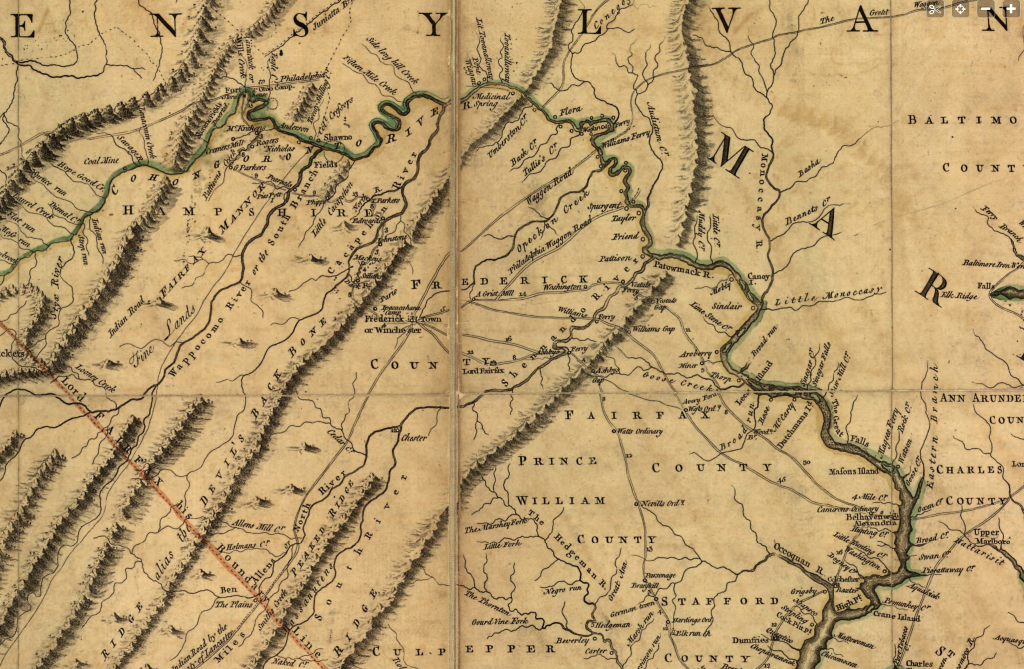
As settlers pushed for more land, councils were held and treaties were negotiated. The Treaty of Albany of 1722 placed a new boundary along the Blue Ridge Mountains and Potomac River, allowing Indian peoples to travel freely north-south on the western side of the treaty line. The Treaty of Lancaster of 1744, negotiated with the Iroquois, moved this line to the foot of the Allegheny’s North Ridge, still allowing Indians to travel along the ancient path, with its name then changed to the Indian Road, as identified on the Joshua Fry and Peter Jefferson map of 1751. The new treaty allowed thousands of settlers to move unopposed deeper into the Shenandoah and Cumberland Valleys.
By the mid 1700s, most American Indian villages had moved north and west as it was no longer safe to remain in the Shenandoah Valley. Some Indian Nations sided with the French, some with the British, while others struggled to remain neutral.
Looking to read more about early American Indians in the Shenandoah Valley? Be sure to visit Native Americans in the Shenandoah Valley, an article researched and written by Cedar Creek & Belle Grove National Historical Park.
| Indian Burial Mounds As Indians were pushed westward, ancestral burial mounds were one of the only signs left in the lands they once roamed. Some were purposely dug up with crude curiosity. Others were plowed over by farmers. Some farmers respected the mounds and plowed around them, adding their field stones as they plowed, protecting, and preserving them. Others plowed over the ancient cemeteries, year after year, uncovering fresh layers of bones with each plowing, casting the bones aside. Massive mounds were reduced and became part of the field. Forever lost. As written by Samuel Kercheval in 1833’s “A History of the Valley of Virginia, “On Mr. Steenbergen’s land are the remains of an Indian mound, though it is now plowed down. The ancient settlers in the neighborhood differ in their opinion as to its original height. When they first saw it, some say in was eighteen or twenty feet high, others that it did not exceed twelve or fourteen, and that it was from fifty to sixty yards in circumference at the base. The mound was literally filled with human skeletons…” Lamenting the loss, Kercheval wrote, “If those mounds and places of burial had been permitted to remain undisturbed, they would have stood as lasting monuments in the history of our country. Many of them were doubtless the work of ages, and future generations would have contemplated them with great interest and curiosity. But these memorials are rapidly disappearing, and the time perhaps will come, when not a trace of them will remain.” 8 Today, the remaining mounds are scattered and few, their whereabouts held secret by conservators, custodians, and archaeologists who know of their existence. |
Shawnee in the Shenandoah Valley
The Shawnee that once roamed the Shenandoah Valley were mostly gone by the 1670s; only a few small settlements remained.
Frederick Town, Virginia was founded by Colonel James Wood in 1744, near a small Shawnee village. The town would be renamed Winchester in February 1752, recognizing Wood’s English birthplace. After living in the area for over 20 years, the Winchester Shawnee were convinced by their Ohio brothers to move westward in 1754, as growing hostilities made it difficult to safely remain in the Shenandoah Valley. They packed their wares and abandoned their homes, leaving behind a ghost town referred to as Shawnee Spring.
Northwest of Winchester, just beyond the forks of the Potomac, the Shawnee had already left their settlement known as King Opessa’s Town in 1732, after almost twenty years of living there. By 1744, Thomas Cresap operated a trading post in King Opessa’s Town and its name evolved into “Oldtown”. A few years later, Cresap and Delaware Nemacolin widened the trail westward and by 1750, Cresap had built a storehouse at Wills Creek (present-day Cumberland, Maryland).
For much of the early 1700’s, most of the Shawnee lived on the Ohio River, but fearing retaliation after the Draper’s Meadows Massacre on July 30, 1755 and other events, they moved their towns up the Scioto River. In February 1756, Andrew Lewis led an expedition of militia and Cherokee from Fort Frederick to raid the Shawnee towns along the Big Sandy Creek and Ohio River. It was no longer safe for many American Indians to travel east of the Allegheny Mountains.

| A Historical Rabbit Hole Mary Draper Ingles was captured by the Shawnee, along with her two sons, during the Draper’s Meadows Massacre. Her story is a fascinating one that you can learn more about here and here and watch a theatrical interpretation of her story here. |
Catawba & Cherokee: Allies of Fort Loudoun
Your Honor spoke of sending some Indians to our assistance; in which no time should be lost, nor means omitted, to engage all the Catawbas and Cherokees that can possibly be gathered together, and immediately dispatched hither. For, without Indians to oppose Indians, we may expect but small success.
George Washington to Governor Robert Dinwiddie, 24 April 1756 11
The Catawba and Cherokee American Indians were British allies during the French & Indian War and frequently visited Fort Loudoun. Washington makes reference to these visits in his letters, which help us understand their role in helping to defend and protect Virginia’s western frontier.
Beginning in the spring of 1757, hundreds of Catawba and Cherokee allies began arriving at Fort Loudoun to either march to Fort Duquesne or assist with scalping parties in the area. These allies were also expecting Fort Loudoun to welcome them with gifts, which was their custom.
Washington wrote to Governor Dinwiddie,
A letter which I received from Capt. Mercer, upon my return to Alexandria, informs me, that 95 Cutawba’s, beside 25 that are gone to Williamsburgh, are now in Winchester, waiting orders how to conduct themselves—That, according to custom they are in want of matchcoats, shirts, leggings, and all other necessaries. I shou’d be glad to receive your Honors particular directions with respect to providing them with those things, and in what manner they are to be employed: as I understand they intend to accompany (in a body) any Troops of ours that may march towards Du Quisne: Or, if no Expedition of that kind is intended, then to go out in small scalping parties against the Enemy.
From George Washington to Robert Dinwiddie, 2 April 1757 12
A couple of weeks later, Captain George Mercer wrote to Washington from Fort Loudoun,
Dear Sir
Thursday and Friday last came to Town 148 Cherokees, with Major Lewis, and yesterday I spoke to them, as they did not chuse an Interview sooner.
Wauhatchee the Head Warriour, after I had told him among many other things, that I was sorry we had not timely Notice of their Coming, that the Governour would have ordered the necessary presents for them, but they might depend upon every thing they could want at their Return, would not receive the Wampum I offered him, as is usual, at the End of the Speech; but immediately got up, & went out of the Council in a great passion.
To George Washington from George Mercer, 24 April 1757 13
Captain Mercer continues to explain how Wauhatchee and his Cherokee warriors think that Governor Dinwiddie and all men of Virginia are liars for promising them gifts in exchange for their support:
From this you may see what their Journey here had almost produced a Revolt of the whole Nation from our Interest, which would have been as certain, as their Return Home dissatisfied […] They make no secret of this, and told me the Govr knew not how to treat Indians; that the French treated them always like Children, and gave them what Goods they wanted.
To George Washington from George Mercer, 24 April 1757 14
Not only does Wauhatchee consider Governor Dinwiddie a liar, but he’s upset over looking like a liar to his own warriors, his own men, for promising them gifts for their fighting:
In his [Wauhatchee] own part, he did not want Presents, but that it was his Promise of great Rewards from the Governour that engaged his young Men to come in, and that the Govr had now made him a Liar amongst his own Warriours: that made him angry.
From all this you see how necessary ’tis to have a proper Present immediately laid in for them. We may soon expect the Catawbas in too, who have an absolute promise of a present from me on their Return. If these Indians go home dissatisfied, we lose the Interest of the whole Nation.
To George Washington from George Mercer, 24 April 1757 15
Captain Mercer tried very diplomatically to work with Wauhatchee and his Cherokee warriors, but you can sense his distress while you read his letter and hear the desperation as he stresses to Washington the importance of not losing their American Indian allies, which is a very powerful takeaway from this letter.
There’s one final letter that we want to break down, in which Washington admits the British’s dependency on its American Indian allies for security during their marches and has biting commentary on their expectations for gifts of gratitude:
There should be great care taken, also, to lay in a supply of proper Goods for them: The Indians are mercenary; every service of theirs must be purchased: and they are easily offended, being thoroughly sensible of their own importance.
George Washington to Brigadier-General Stanwix, April 10th 1758 16
- “From George Washington to Adam Stephen, 18 May 1756,” Founders Online, National Archives, https://founders.archives.gov/documents/Washington/02-03-02-0158. [Original source: The Papers of George Washington, Colonial Series, vol. 3, 16 April 1756–9 November 1756, ed. W. W. Abbot. Charlottesville: University Press of Virginia, 1984, pp. 157–163.] ↩︎
- Calloway, Colin G. “The Indian World of George Washington, The First President, the First Americans, and the Birth of the Nation” Oxford University Press, 2018, pg 38 ↩︎
- Tanaghrisson, the half King (U.S. National Park Service). (n.d.). https://www.nps.gov/people/tanaghrisson-the-half-king.htm ↩︎
- Point of View — Sculpture on Mount Washington — meeting of George Washington and Seneca leader Guyasuta in 1770. (n.d.). https://www.jimwestsculptor.com/work/point-of-view ↩︎
- Huntington, Daniel (1816-1906). Warner Foundation. (2021, July 2). https://warnerfoundation.org/huntington-daniel-1816-1906/ ↩︎
- Colonial Office Records, ser 5, National Archives, Kew, England, Journal of Major George Washington, 19; Diaries of GW 1:151-52 ↩︎
- HISTORY. (2017, September 6). Fast facts about the Proclamation of 1763 | History [Video]. YouTube. https://www.youtube.com/watch?v=HKNTBHmWOyA ↩︎
- Kercheval, S. (1902). A History of the Valley of Virginia. ↩︎
- Fry, J., Jefferson, P. & Jefferys, T. (1755) A map of the most inhabited part of Virginia containing the whole province of Maryland with part of Pensilvania, New Jersey and North Carolina. [London, Thos. Jefferys] [Map] Retrieved from the Library of Congress, https://www.loc.gov/item/74693166/. ↩︎
- “Mary Draper Ingles,” Virginia Changemakers, accessed April 8, 2024, https://edu.lva.virginia.gov/changemakers/items/show/196. ↩︎
- “From George Washington to Robert Dinwiddie, 24 April 1756,” Founders Online, National Archives, https://founders.archives.gov/documents/Washington/02-03-02-0044. [Original source: The Papers of George Washington, Colonial Series, vol. 3, 16 April 1756–9 November 1756, ed. W. W. Abbot. Charlottesville: University Press of Virginia, 1984, pp. 44–47.] ↩︎
- “From George Washington to Robert Dinwiddie, 2 April 1757,” Founders Online, National Archives, https://founders.archives.gov/documents/Washington/02-04-02-0071. [Original source: The Papers of George Washington, Colonial Series, vol. 4, 9 November 1756 – 24 October 1757, ed. W. W. Abbot. Charlottesville: University Press of Virginia, 1984, pp. 126–128.] ↩︎
- “To George Washington from George Mercer, 24 April 1757,” Founders Online, National Archives, https://founders.archives.gov/documents/Washington/02-04-02-0078. [Original source: The Papers of George Washington, Colonial Series, vol. 4, 9 November 1756 – 24 October 1757, ed. W. W. Abbot. Charlottesville: University Press of Virginia, 1984, pp. 139–142.] ↩︎
- “To George Washington from George Mercer, 24 April 1757,” Founders Online, National Archives, https://founders.archives.gov/documents/Washington/02-04-02-0078. [Original source: The Papers of George Washington, Colonial Series, vol. 4, 9 November 1756 – 24 October 1757, ed. W. W. Abbot. Charlottesville: University Press of Virginia, 1984, pp. 139–142.] ↩︎
- “To George Washington from George Mercer, 24 April 1757,” Founders Online, National Archives, https://founders.archives.gov/documents/Washington/02-04-02-0078. [Original source: The Papers of George Washington, Colonial Series, vol. 4, 9 November 1756 – 24 October 1757, ed. W. W. Abbot. Charlottesville: University Press of Virginia, 1984, pp. 139–142.] ↩︎
- “From George Washington to John Stanwix, 10 April 1758,” Founders Online, National Archives, https://founders.archives.gov/documents/Washington/02-05-02-0087. [Original source: The Papers of George Washington, Colonial Series, vol. 5, 5 October 1757–3 September 1758, ed. W. W. Abbot. Charlottesville: University Press of Virginia, 1988, pp. 117–120.] ↩︎
- George Washington’s Mount Vernon. (2020, September 4). How did George Washington get along with Native Americans? #AskMountVernon [Video]. YouTube. https://www.youtube.com/watch?v=FaG3YyJDDGk ↩︎

This exhibit was made possible, in part, by a grant from the VA250 Commission in partnership with Virginia Humanities.

Exhibit researched and written by Jess Pritchard-Ritter, Donna Leight, and David Grosso. Created by For the Love of History Consulting, LLC.